What It Is From the Phrasebook The 15 Chapters Book Two Get the Book
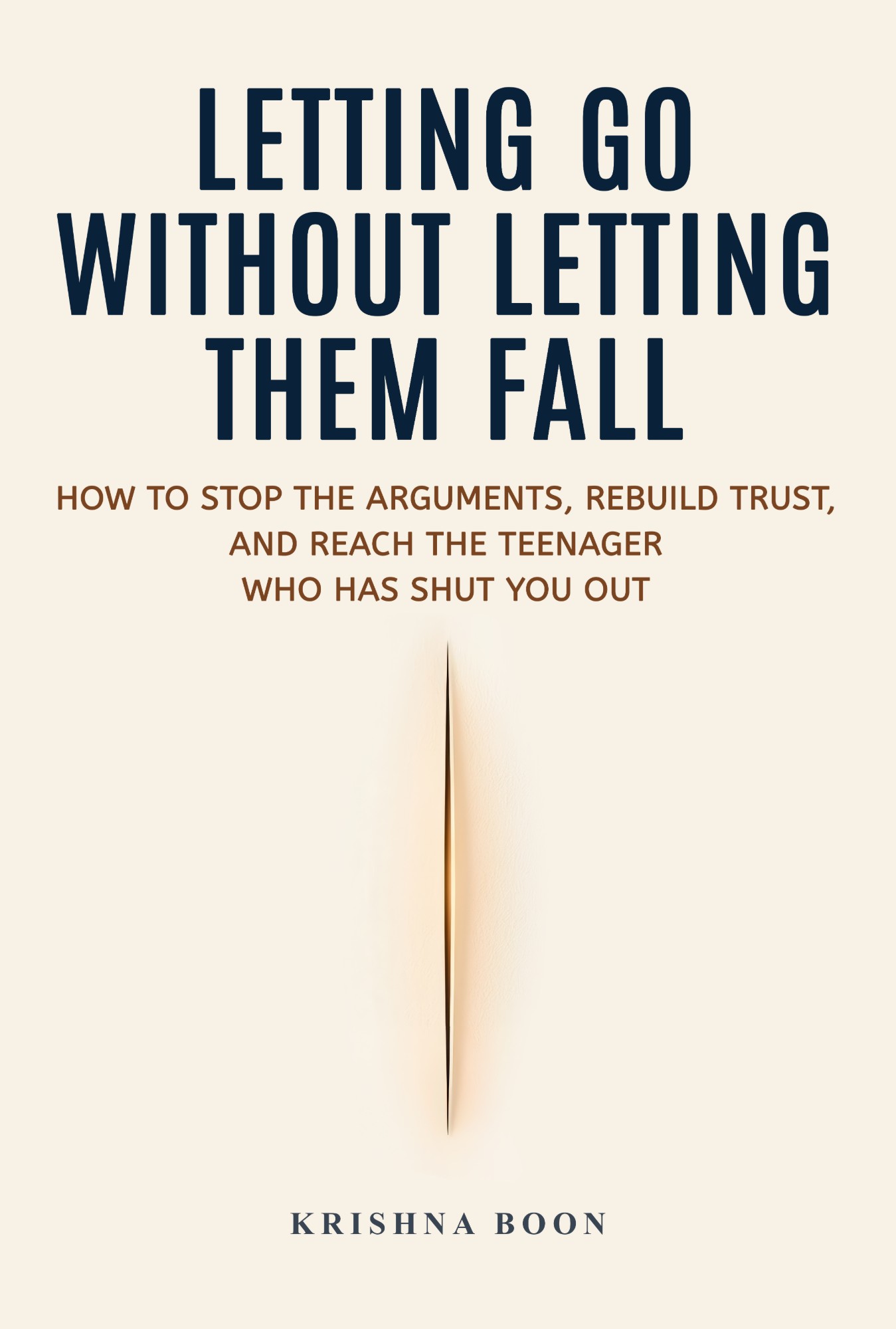
Letting Go Without Letting Them Fall, book cover by Krishna Boon
Krishna Boon · The Relational Conflict Series · Book One

Letting Go Without Letting Them Fall

How to Stop the Arguments, Rebuild Trust, and Reach the Teenager Who Has Shut You Out

For Parents of Teens 15 Chapters · 5 Parts On Amazon

The Relational Conflict Series · On Amazon

✦ What It Is

The love was there the whole time. It just arrived looking like something else.

Something goes wrong, and you react while you’re still hot, and a little trust thins out between you. Then you feel them slipping away, so you hold on tighter, and the tighter holding pushes them further off, which frightens you, so you tighten again. Conflict, then broken trust, then control. Most homes are somewhere on that line right now, and most of us have never stopped long enough to give it a name.

There’s no system in this book, no ten steps that turn a house full of arguments into a peaceful one by the end of the month. What’s here instead is that single pattern, looked at slowly and from several sides, by a father who raised a daughter and a son.

Anger doesn’t come from a shortage of love. It comes from love that couldn’t find its proper way out, and went through the nearest door instead.

Fear of losing them comes out as control. Fear for them comes out as anger. And very often, the book suggests gently, it isn’t the child’s mindset that has to change first. Your own is the one thing in the situation you can actually reach.

Parenting Teens Family Conflict Rebuilding Trust Communication
✦ From the Phrasebook

The things parents actually say, and what lands instead

The book ends with a working phrasebook: the sentences we reach for without choosing them, usually while tired, and a version that gets closer to what we meant. Here are three of them.

Appendix · The Phrasebook

When they’ve done something wrong

Said“You’re so lazy.”

Lands asThis is what I am, and there’s nothing to be done about it.

Try“The bins are still there and you said you’d do them before dinner.”

One is a character. The other is a Tuesday, and a Tuesday can be fixed.

Said“What is wrong with you?”

Lands asThere’s something faulty in me.

Try“That’s not like you. What’s going on?”

The second version assumes the behaviour is the exception. Children generally rise or fall to whichever assumption you hand them.

Said“I’m not angry, I’m disappointed.”

Lands asYour opinion of me has permanently changed.

Try“I’m angry about this, and I’ll be over it. I wanted to tell you why.”

Anger passes and can be seen passing. Disappointment sounds like a revised verdict with no expiry date.

Read it once through. Then pick two.
✦ What's Inside

Five parts, fifteen chapters

From the years when you are the whole world to them, through the wall every teenager has to hit, to what your child ends up teaching you. Plus a coda, the phrasebook, and full notes and sources.

Part One — The Innocent Years
01The Whole World, Small
02The Wall They Need to Hit
03What Fear Teaches, and What It Doesn't
Part Two — The Wall They Have to Hit
04When the Ground Shifts
05The Grip
06The World Arrives
Part Three — Before You Speak
07The Heat Before the Words
08Quiet Isn't Weakness
09What I Wish I Hadn't Said
Part Four — What They Watch, Not What You Say
10The Words We Use Every Day
11Do As I Say
12Trust, Broken and Rebuilt
Part Five — My Child, My Teacher
13What My Child Taught Me
14Letting Go Without Disappearing
15Still Here, Still Theirs
A note of care. This book is written for the ordinary difficulty between a parent and a child in a home where everyone is safe. If what is happening involves violence, abuse, addiction, self-harm, suicidal thinking or risk to anyone's life, it needs help from outside the family now, starting with a doctor.
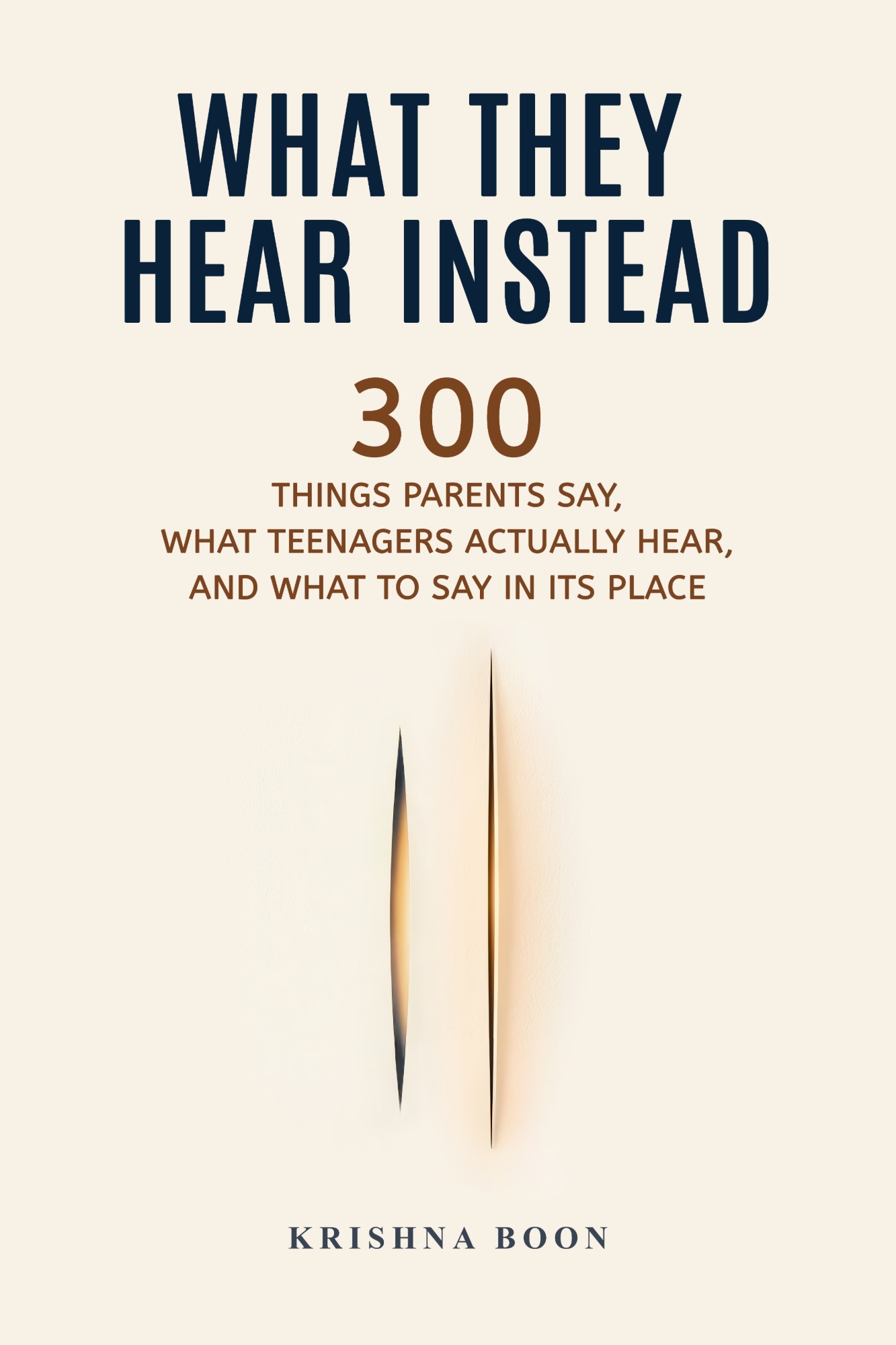
What They Hear Instead, book cover by Krishna Boon
✦ Book Two · The Practical Companion

What They Hear Instead

Three hundred things parents say, what teenagers actually hear, and what to say in its place. Smaller and more practical: the sentence itself, and where it goes after it leaves you.

Discover Book Two →
✦ Get the Book

Letting Go Without Letting Them Fall

The Relational Conflict Series · Book One · On Amazon
Buy on Amazon ↗

Use Amazon's "Look inside" to read the opening pages first

✦ Stay in the Circle ✦

New stories. New music.

Receive What the Voice Leaves Behind — a free story written only for readers here, found nowhere else — plus early word of each new book, including the next book in the Relational Conflict Series.

No spam. No frequency promises. Only when there is something worth sharing.

Official Author Contact: enquiry@krishnaboon.online / contact@krishnaboon.online