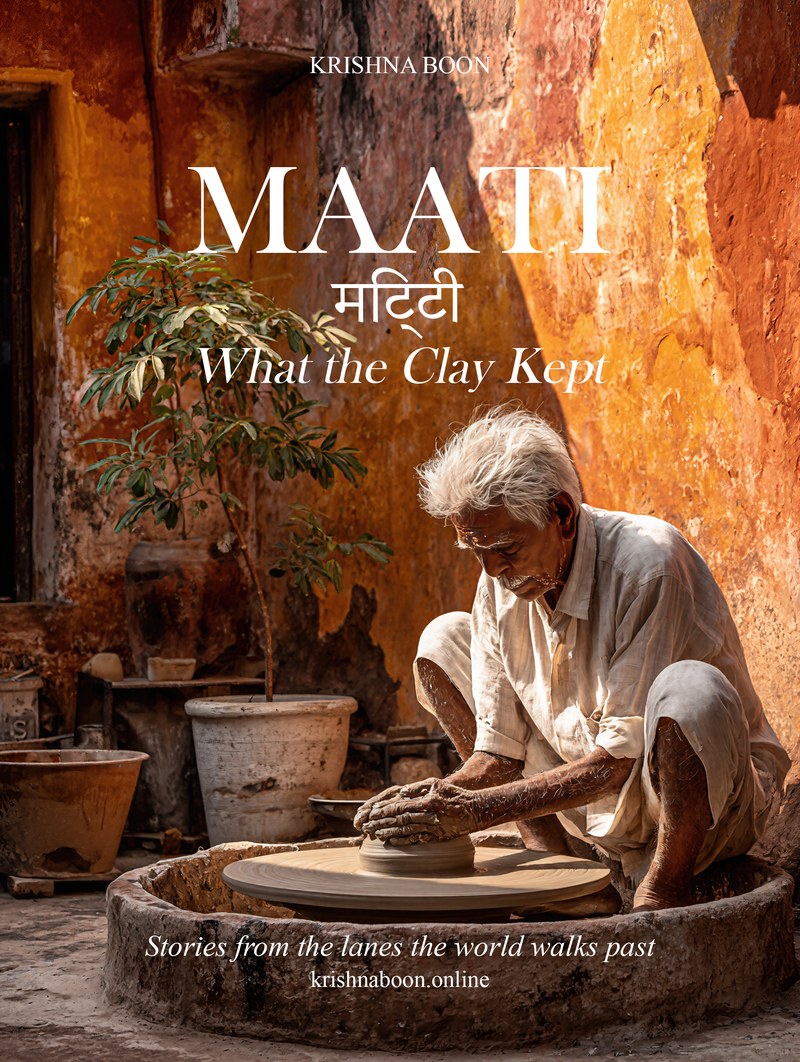
What the Clay Kept
Dhanraj has spent sixty years at the wheel in a narrow lane in Khurja, shaping clay into bowls, into birds, into everything except the words he never found for his son. His hands — which have always been moving, always shaping — have begun to tremble.
The wheel turned slower these days. His hands rested on the clay, waiting for it to find its centre. They used to know this without thinking. Now they trembled faintly. — Maati, Prologue
Vikram has spent eleven years in Pune, building towers out of glass and concrete, sending money home through a middleman named Salim, telling himself this is enough. It has always been easier than going back. Then Salim calls. A fall near the kiln. A bruised hip. Nothing broken. The doctor says not to worry.
But Vikram takes a fourteen-hour train anyway. And in a trunk in the loft, wrapped in a square of faded blue cloth, he finds a notebook in his mother's handwriting. A story she told him every night as a child, about a boy who walked beside people when they were afraid. A story he thought he had forgotten. A story that is longer than he remembers — and hiding something at its back pages that changes the shape of his entire life.
He had never been alone. He simply hadn't known who was there. — Maati, Chapter Six
Maati is a story about what grief does to love when it has nowhere to go. About fathers who stay without knowing how to speak. About mothers who give their dead children a second life made entirely of kindness. About the things we carry for forty years without knowing their name — and what happens, finally, when we set them down.
Set in Khurja, Uttar Pradesh — India's blue pottery town — this is the third story in Krishna Boon's collection of quiet fiction from the lanes the world walks past. It stands entirely on its own.